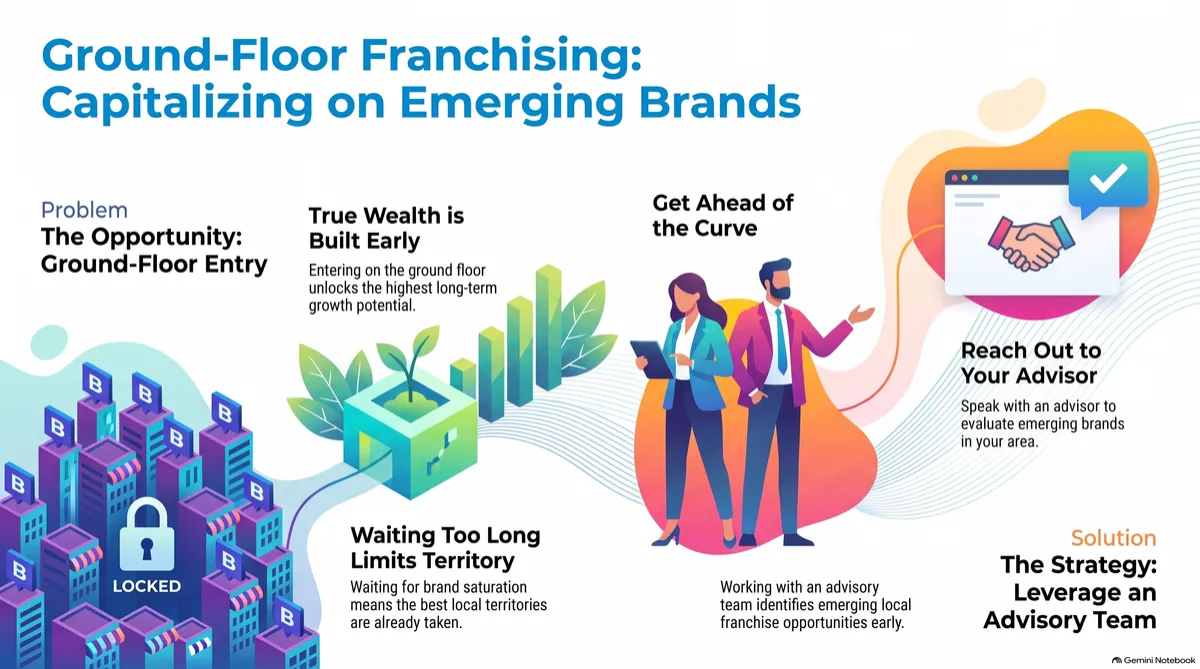
Ground-Floor Franchise Investment Strategy: Capitalizing on Emerging Brands and Advisory Expertise
Ground-Floor Franchise Investment Strategy: Capitalizing on Emerging Brands and Advisory Expertise
1. The Ground-Floor Imperative: Early-Stage vs. Late-Stage Franchise Acquisition
Timing is the foundational determinant of long-term capital growth and competitive positioning in franchise acquisitions. Entering a franchise system at the appropriate stage dictates not only the physical footprint an investor can secure, but also the ultimate ceiling of their wealth creation. While many market participants prioritize late-stage brand recognition, maximum equity upside is captured by acquiring assets during the emerging phase of a franchise lifecycle.
1.1 The Paradox of Late-Stage Entry
A common mistake among investors is delaying entry until a franchise brand has achieved critical mass and appears "on every corner." While widespread visibility provides perceived security, this delay directly results in missing out on prime territories and introduces severe operational and growth limitations:
Exhaustion of Prime Territories: By the time a brand achieves pervasive market presence, the highest-performing geographical territories are already gone, having been claimed by early entrants.
Forfeited Equity Upside: Waiting for market saturation shifts the asset profile from an aggressive capital growth opportunity to a late-stage acquisition with reduced equity upside.
Restricted Expansion Potential: Investors attempting late-stage entry face constrained local footprints due to territory loss, severely limiting their ability to scale multiple units within a single target market.
1.2 Foundational Wealth Creation on the Ground Floor
The central premise of high-yield franchise investing is that true wealth is built on the ground floor. Capturing an emerging brand early allows investors to secure optimal baseline conditions and prime territory control before value appreciation and saturation are priced into the market.
Late-Stage Entry (Market Saturation) | Ground-Floor Acquisition (Early-Stage) |
|---|---|
Territory Availability: Best local territories are already claimed and unavailable. | Territory Availability: Complete access to prime, high-demand geographic territories. |
Wealth Creation Potential: Limited capital growth due to established, saturated market presence. | Wealth Creation Potential: Maximum long-term wealth creation built from foundational growth. |
Competitive Positioning: Entry occurs after widespread brand visibility ("on every corner"). | Competitive Positioning: Strategic positioning established ahead of the broader market curve. |
Recognizing the fundamental value of ground-floor timing naturally leads to the necessity of securing prime geographical markets before competitors enter the landscape.
2. Territory Securitization and Early-Mover Advantage
Securing target territorial rights is the primary engine of long-term franchise asset value. An early-mover strategy transforms market selection from a reactive exercise into a proactive, capital-preservation mechanism.
2.1 Evaluating Market Saturation vs. Prime Territory Control
When acquisition decisions are delayed until a franchise brand reaches universal visibility, the mechanics of territory loss become irreversible. Late entrants are forced to accept secondary market locations or constrained boundaries because the best territories are gone, directly impacting customer access and revenue potential. Conversely, entering prior to market saturation ensures complete control over key demographic corridors and high-growth target markets.
Key Strategic Takeaway: Waiting until a franchise brand is visible on every corner guarantees that the best territories are already gone. True wealth creation requires securing ground-floor control over prime local markets before widespread expansion occurs.
Securing early territory advantages requires rigorous strategic execution, which is best achieved through direct collaboration with specialized advisors.
3. Strategic Execution Through Advisory Collaboration
Navigating the emerging brand landscape demands specialized expertise to identify high-potential opportunities prior to widespread public recognition. Professional advisory collaboration serves as the critical mechanism for navigating emerging brand landscapes effectively and converting early timing into sustainable portfolio value.
3.1 Getting Ahead of the Curve
Partnering with a specialized advisory team grants prospective franchise owners a distinct competitive advantage in market timing and opportunity selection:
Market Foresight and Positioning: Working directly with your advisory team will help get you in front of the curve for an emerging franchise brand in your target local area.
Early Opportunity Identification: Advisors evaluate and highlight early-stage concepts before they achieve mass visibility, allowing clients to secure prime geographical footprints before territories are locked out.
Strategic Portfolio Alignment: Advisory guidance helps align local target market demographics with the optimal entry window for emerging brands, maximizing capital growth potential.
3.2 Actionable Next Steps: Advisor Engagement
To capitalize on ground-floor advantages before local territory rights are claimed by competing investors, decisive action is required. Reach out and speak with your advisor today to evaluate emerging franchise opportunities in your area and secure your ground-floor position.
Proactive engagement with an advisory team converts early-stage potential into tangible wealth creation.